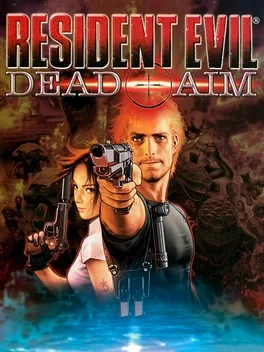
Resident Evil: Dead Aim
Table of Contents
Introduction
Resident Evil: Dead Aim, also known in Japan as Gun Survivor 4: Biohazard - Heroes Never Die, stands as one of the most experimental entries in Capcom’s legendary survival-horror franchise. Released exclusively for the PlayStation 2, it sought to bridge the gap between the frantic arcade action of the light gun genre and the methodical, atmosphere-heavy exploration that defined the main series. While earlier entries in the Gun Survivor spin-off series were met with mixed reviews due to their departure from standard survival mechanics, Dead Aim refined the formula, creating a unique hybrid experience that remains a cult classic among horror enthusiasts today. It represents a bold moment in the series' history where Capcom successfully blended multiple genres into a cohesive, terrifying package.
Story & Setting
The narrative of Resident Evil: Dead Aim takes players away from the Raccoon City streets and onto the claustrophobic corridors of a luxury ocean liner, the Spencer Rain. The plot follows Bruce McGivern, a member of the United States Strategic Command (USSTRATCOM), who is sent to investigate the ship after it is hijacked by Morpheus D. Duvall, a rogue former Umbrella researcher. Morpheus has stolen samples of a new experimental virus and threatens to launch missiles at major global cities unless his demands are met. Bruce isn't alone, however; he eventually teams up with Fong Ling, a mysterious agent from the Chinese Ministry of State Security. Their uneasy alliance forms the emotional core of the game as they navigate the virus-infested ship and eventually reach a secret island facility, uncovering the depths of Morpheus's madness.
Gameplay
What truly sets Dead Aim apart is its dual-perspective gameplay. When exploring the environment, the camera adopts a third-person view, allowing players to navigate Bruce or Fong Ling through the environment with the fluidity expected of a survival horror title. However, the moment the player prepares to fire, the perspective shifts instantly to a first-person view. This transition was designed to accommodate the Namco GunCon 2 light gun controller, though the game is fully playable with a standard DualShock 2. Resource management remains a critical pillar of the experience. Players must scour the ship for medicinal herbs and ammo for a variety of weapons, including a magnum, a shotgun, and an assault rifle. Unlike the arcade-focused predecessors in the series, zombies in Dead Aim are remarkably resilient and ammo can be very scarce, forcing players to make every shot count to survive the nightmare.
This game was released on several platforms, including various regional versions of the PlayStation 2.
Legacy
Historically, Resident Evil: Dead Aim is significant for being the first game in the franchise to feature a third-person camera that moved with the character in a fully 3D environment, a precursor to the revolutionary camera system seen in Resident Evil 4. While the Gun Survivor series ended after this fourth entry, Dead Aim is widely considered the pinnacle of that specific sub-series. It successfully integrated the tension of survival horror with the precision of a light gun shooter, proving that Capcom was willing to take risks with their most valuable intellectual property during the sixth console generation. The game's influence can be seen in later titles that experimented with over-the-shoulder perspectives and more action-oriented gameplay loops.
Fun Facts
One of the most striking aspects of the game is the main antagonist, Morpheus D. Duvall, who undergoes a unique mutation that gives him a feminine appearance after injecting himself with a variant of the T+G Virus. Additionally, despite its title, the game features a romantic subtext between Bruce and Fong Ling that was somewhat rare for the series at the time. Finally, the game’s Japanese title, Gun Survivor 4: Biohazard - Heroes Never Die, is often cited by fans for its more cinematic flair compared to the western release name. The game also features a unique save room theme that maintains the series' tradition of providing a brief, haunting respite from the chaos, though it is often overlooked compared to the themes of the mainline games.