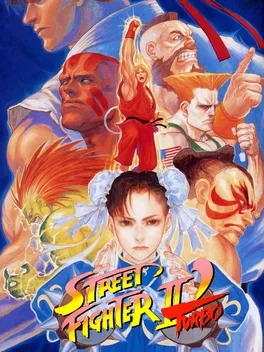
Street Fighter II' Turbo
Introduction
They're back, and they're badder than ever! For many fans of the fighting game genre, the early 1990s represented a golden era defined by arcade competition and household rivalries. At the center of this storm was Street Fighter II' Turbo, a title that redefined what players expected from a home console port. Known by several titles including Street Fighter II' Turbo: Hyper Fighting, Street Fighter II Turbo, and sometimes simply SFIIT or Street Fighter II' HF, this game was Capcom’s definitive response to the evolving arcade scene. It took the rock-solid foundation of the original World Warrior and injected it with blistering speed and refined mechanics, ensuring its place as one of the most beloved entries in the series.
Story & Setting
The narrative of Street Fighter II' Turbo follows the second World Warrior tournament, a global martial arts competition organized by the mysterious and villainous organization known as Shadaloo. The tournament's host, M. Bison, seeks to find the strongest fighters on the planet to either recruit them into his criminal empire or eliminate them as potential threats. Twelve of the greatest fighters from across the globe—from the disciplined Ryu and the vengeful Guile to the lightning-fast Chun-Li—are ready to battle. Each character has their own personal motivation, whether it be seeking a lost father, avenging a fallen comrade, or proving their martial prowess. Players must choose their champion and fight through eleven formidable opponents to earn the right to face M. Bison for the ultimate title.
Gameplay
At its core, the gameplay of Street Fighter II' Turbo is about precision, timing, and strategy. This version significantly increased the gameplay speed compared to its predecessors, a feature known as "Turbo mode." On the Super Nintendo version, players could even use a cheat code to unlock up to ten stars of speed, though the base game offered four selectable speeds.
Beyond just speed, the game integrated features from the "Champion Edition," most notably making the four Grand Masters—Balrog, Vega, Sagat, and M. Bison—fully playable characters. Furthermore, many characters received brand-new special moves to help balance the roster. For instance, Chun-Li gained the "Kikoken" projectile, and E. Honda was given the "Sumo Smash." These additions, combined with the faster pace, forced veteran players to relearn their strategies and timing, making Street Fighter II' HF a much more aggressive and dynamic experience than the original 1991 release.
This iconic fighting game has been released on several platforms, including Nintendo's home consoles and handheld systems, ensuring its accessibility for decades.
Legacy
The legacy of Street Fighter II' Turbo is hard to overstate. It is often cited as the peak of the 16-bit fighting game era. While the Sega Genesis/Mega Drive received a similar update titled "Street Fighter II: Special Champion Edition," the SNES version of Turbo remained a benchmark for how to translate a high-fidelity arcade experience to a home console. Its success proved that the competitive fighting game community was hungry for faster, more technical gameplay, leading directly to the "Hyper" and "Turbo" naming conventions that persist in the industry today. Even decades later, it remains a staple in retro gaming collections and is frequently included in Capcom’s various anniversary compilations.
Fun Facts
- The creation of the "Hyper Fighting" arcade version was actually a response to pirated "hacked" versions of Street Fighter II (like the infamous Rainbow Edition) that allowed players to change characters mid-match and fire multiple projectiles.
- In the SNES version, you can unlock higher turbo speeds by pressing a specific button combination on the controller during the logo screen.
- This was the final version of Street Fighter II to be released before the jump to the "Super" series, which introduced the New Challengers like Cammy and T. Hawk.
- Despite the "Turbo" branding, the game actually contains two modes: "Normal," which plays like the Champion Edition, and "Turbo," which includes the speed increases and new moves.