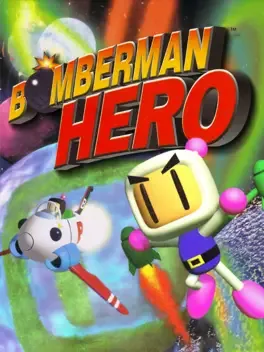
Bomberman Hero
Introduction
Released in 1998, Bomberman Hero represents a fascinating departure from the traditional grid-based puzzles that defined the earlier entries in the series. While the franchise was primarily known for its competitive multiplayer and maze-like stages, this title took a bold leap into the realm of 3D platforming. It was a time of experimentation for many 2D mascots, and our explosive protagonist was no exception. By trading in the fixed camera and tactical positioning for a more fluid, action-oriented experience, the game offered fans a chance to see Bomberman as a true action star. Whether you were a long-time veteran or a newcomer to the Nintendo 64 era, Bomberman Hero provided a unique, vibrant journey that remains a standout curiosity in gaming history.
Story & Setting
The narrative kicks off with a galactic crisis. Princess Millian of the Primrose Planet has been kidnapped by the sinister Garaden Empire, an evil force looking to seize control of the universe. In an effort to stop them, Bomberman embarks on an epic quest across the galaxy to rescue the Princess and foil the Empire's plans. The adventure spans several diverse planets, each featuring distinct elemental themes. Players will traverse the icy peaks of Planet Kanatia, navigate the scorching volcanic landscapes of Planet Mazone, and dive into the depths of aquatic worlds. The setting is much larger in scope than previous entries, emphasizing a grand space-opera feel that gives Bomberman’s mission a sense of urgency and scale. Along the way, he is aided by the robot Pibol and several other allies in his quest to free the universe from tyranny.
Gameplay
The gameplay of Bomberman Hero is what truly sets it apart from its predecessors. Most notably, this was one of the first games in the series where Bomberman could jump freely, a mechanic that fundamentally changed level navigation. Instead of being confined to a grid, players explore fully realized 3D environments. Bomberman can throw bombs, kick them, and use a variety of power-ups to enhance his explosive capabilities.
A major highlight of the experience is the introduction of specialized vehicles and movement modes. The Bomber Copter allows for aerial traversal, while the Bomber Marine is essential for underwater stages. There is even a Bomber Jet and Bomber Slider to keep the pacing fast and varied. These transformations, combined with help from the rabbit-like Louie, ensure that the platforming never feels stagnant. Unlike other titles in the series, the focus here is strictly on the single-player campaign, featuring a health bar system and branching paths that lead to different endings based on the player's performance and item collection.
This game was released on several platforms, including the Nintendo 64 and later the Wii, ensuring that multiple generations of players could experience the transition to 3D. In its native Japan, the title is often referred to as Bomberman Hero: Millian-Oujo wo Sukue! or Bomberman Hero: Mirian-Oujo wo Sukue!, reflecting the core mission of saving the Princess.
Legacy
Bomberman Hero is often remembered as a cult classic, particularly for its daring shift in genre. While some fans at the time missed the traditional battle mode, many grew to appreciate the game's creative level design and its ambitious attempt to modernize the franchise. One of its most enduring legacies is its incredible soundtrack, composed by Jun Chikuma. The music features a unique blend of drum and bass, jungle, and acid techno, which was highly unusual for a mascot platformer. This energetic, high-tempo score gave the game a cool, modern aesthetic that still resonates with VGM enthusiasts today. It serves as a reminder of an era when developers weren't afraid to take massive risks with established IPs to see what would stick in the third dimension.
Fun Facts
- Despite the series being famous for its multiplayer, Bomberman Hero is one of the few main-series entries to feature no multiplayer mode at all, focusing entirely on the solo platforming adventure.
- The game features a "hidden" fifth planet that players can only access if they achieve a high enough rank across all previous stages.
- The character Louie, the helpful rabbit, makes a return here, serving as a rideable mount that improves Bomberman’s jumping and speed.
- The soundtrack's heavy drum and bass influence was inspired by the underground club scene in Japan during the late 90s, making it one of the most distinct audio experiences on the Nintendo 64.