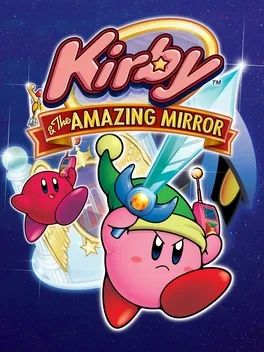
Kirby & the Amazing Mirror
Introduction
Kirby has always been a character defined by his versatility and charm. However, in 2004, the series took a bold leap into the "Metroidvania" genre with Kirby & the Amazing Mirror. Known in Japan as Hoshi no Kirby: Kagami no Daimeikyū, this title offered players a sprawling, non-linear adventure that was quite a departure from the traditional stage-to-stage progression found in previous entries like Kirby: Nightmare in Dream Land. Whether you know it as Kirby et le Labyrinthe des Miroirs in French-speaking regions or Kirby & die wundersame Spiegelwelt in Germany, the game stands as a unique gem in the pink puffball's extensive library, emphasizing exploration and teamwork over linear pathing.
Story & Setting
High above the skies of Dream Land sits the Mirror World, a realm where every wish reflected in the Mirror is granted. However, a corrupting influence known as Dark Mind begins to twist these reflections into nightmares. When Meta Knight flies up to investigate, he is defeated by a shadowy version of himself—Dark Meta Knight. To prevent interference, the doppelganger attacks Kirby, splitting him into four colored versions of himself: pink, yellow, red, and green. These four Kirbys must traverse the massive, interconnected Mirror World to find the eight shards of the shattered Dimension Mirror, defeat the darkness, and rescue the real Meta Knight. The setting is notably more complex than typical Dream Land locales, featuring a labyrinthine design that encourages players to get lost in its secrets.
Gameplay
The core mechanics of Kirby & the Amazing Mirror emphasize exploration and cooperation. Unlike other Kirby games, the Mirror World is one massive, continuous map. Players must navigate through various zones, finding buttons and mirrors that act as portals to other regions. A key feature is the "Communication Phone." Kirby can use this to call his three companions to his location to help solve puzzles or defeat bosses. This mechanic allowed for a seamless four-player cooperative experience via the GBA Link Cable, though AI-controlled Kirbys take over in single-player mode.
The game introduced several new copy abilities, such as Cupid (allowing Kirby to shoot arrows) and Missile, alongside melee-focused moves like the Smash ability, which mimics Kirby's moveset from the Super Smash Bros. series. For those seeking a break from the main quest, the title features addictive sub-games like Crackity Hack, a timing-based test of strength, and Speed Eaters, which challenges players to gobble up food as fast as possible to satisfy Kirby's legendary appetite.
Kirby's labyrinthine adventure has been made available on various Nintendo hardware over the years, ensuring fans of different generations can enjoy the quest across handheld and home consoles.
Legacy
Kirby & the Amazing Mirror is often cited by fans as one of the most innovative titles in the series. By blending the classic Kirby charm with an open-ended exploration format, it provided a level of depth and replayability that was rare for handheld titles at the time. Its cooperative focus laid the groundwork for future multiplayer Kirby titles, such as Kirby Star Allies and Kirby's Return to Dream Land. The game's vibrant art style and complex map design have allowed it to age gracefully, maintaining a dedicated following decades after its initial release. It remains a standout example of how a long-running franchise can successfully experiment with its core formula while remaining true to its roots.
Fun Facts
The game was a collaborative effort between Flagship (a studio founded by Capcom), HAL Laboratory, and Nintendo. Interestingly, the "Smash" ability found in this game gives Kirby his exact moveset from Super Smash Bros. Melee, including his Hammer, Final Cutter, and Stone attacks. Around the world, the game is recognized by several titles, including Kirby et le Labyrinthe des Miroirs and Hoshi no Kirby: Kagami no Daimeikyū. Another interesting detail is that this is one of the few Kirby games where King Dedede does not make a physical appearance, as the focus is entirely on the new threats within the Mirror World. Additionally, the game's map was so intricate that it served as an inspiration for the "Great Maze" in the Subspace Emissary mode of Super Smash Bros. Brawl.