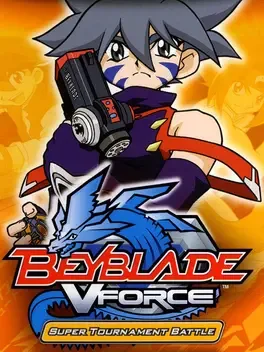
Beyblade VForce: Super Tournament Battle
Introduction
Story & Setting
Gameplay
Platforms
Legacy
Fun Facts
Introduction
During the peak of the early 2000s anime boom, few franchises captured the imagination of children quite like Beyblade. As the "Plastic Generation" reached its zenith, developers sought to bring the high-octane spinning action of the Beystadium to home consoles. Beyblade VForce: Super Tournament Battle, also known in Japan as Bakuten Shoot Beyblade 2002 and often referred to simply as BeyBlade: Super Tournament Battle in North American markets, was the premier effort to bring the franchise to the 128-bit era. Released for the Nintendo GameCube, this role-playing battle game aimed to synthesize the strategic depth of part customization with the visceral excitement of the VForce anime season. It stands as a nostalgic milestone for fans who spent their afternoons shouting "Let it Rip!" and watching mythical beasts clash in plastic arenas.
Story & Setting
The narrative of Beyblade VForce: Super Tournament Battle is a direct adaptation of the second season of the original anime series. The world is one where professional Beyblading is a global phenomenon, supported by massive stadiums and a high-tech infrastructure. Players are immersed in the saga of the Bladebreakers—Tyson, Kai, Ray, and Max—as they navigate the treacherous waters of international competition. The setting is defined by the high stakes of the VForce era, where the mysterious Team Psykick and the Saint Shields emerge as formidable threats. Unlike the first season, VForce introduces the concept of Cyber Bit-beasts and attempts to capture the legendary spirits residing within the Bladebreakers' tops. The game places the player in the middle of this conflict, allowing them to rise through the tournament ranks while interacting with the iconic cast of characters that defined a generation of competitive gaming.
Gameplay
At its core, Beyblade VForce: Super Tournament Battle is a mix of strategic customization and real-time physics simulation. The gameplay is split into two primary phases: preparation and combat. In the preparation phase, players must dive into the deep RPG-style customization menus. Every Beyblade is composed of several modular components, including the Attack Ring, Weight Disk, and Blade Base. Selecting these parts is not merely aesthetic; it significantly alters the Beyblade's weight, friction, and movement patterns. Players must decide whether they want a heavy-defense build that can outlast opponents or a high-velocity attack build designed for early knockouts.
Once in the Beystadium, the gameplay shifts to an active battle system. Players must master the "Shoot" mechanic, where the timing of the launch determines the initial RPM and positioning. The Nintendo GameCube's analog stick is used to influence the Beyblade's movement across the arena, allowing players to hunt down their rivals or avoid dangerous hazards. A power meter builds up during the clash, and when it reaches its peak, players can summon their Bit-beast. These summons trigger cinematic special attacks, where spirits like Dragoon, Dranzer, or Driger appear to deal massive damage or provide a strategic buff. Winning matches earns points that can be spent in the shop to unlock rarer, more powerful parts, creating a rewarding loop of progression.
This title was made available exclusively on the Nintendo GameCube across multiple global regions.
Legacy
While Beyblade VForce: Super Tournament Battle received mixed reviews from mainstream critics who found its niche appeal narrow, it holds a significant place in the history of the franchise. It was the first Beyblade game to utilize the power of the GameCube, providing visual fidelity and physics calculations that were impossible on earlier hardware or handhelds. For many fans, this game was the definitive digital representation of the "Plastic Gen" era. Its legacy is found in its faithful recreation of the anime's atmosphere and its surprisingly complex customization system, which predated the more streamlined mechanics of later Metal Fusion and Burst titles. It remains a sought-after collectible for GameCube enthusiasts and anime historians alike.
Fun Facts
- The game was originally released in Japan on December 19, 2002, as Bakuten Shoot Beyblade 2002, which coincided with the peak of the anime's popularity in that region.
- In the Western release, BeyBlade: Super Tournament Battle, players can unlock hidden characters from the first season of the anime, allowing for dream matches between different eras of the show.
- The game features the specific "V-Series" designs of the iconic Beyblades, which were known for their magnetic core systems in the real-life toy line.
- It is one of the few games where the environment of the Beystadium (like water or magnets) can have as much impact on the outcome as the players' spinning tops.