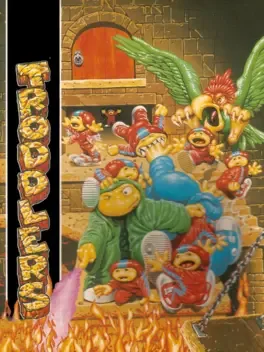
Troddlers
Introduction
During the golden age of 16-bit puzzle games, developers were constantly looking for the next big hook to follow in the footsteps of giants like Lemmings. Released in the early 1990s, Troddlers emerged as a clever, high-energy alternative that blended the "save-them-all" rescue mechanics of its predecessors with the block-manipulation strategy seen in titles like Solomon's Key. Developed by Sales Curve and published by Vic Tokai, the game challenges players to use their wits, reflexes, and spatial awareness to guide a group of mindless creatures through increasingly complex environments. It is a game defined by its unique gravity-defying mechanics and its charming, albeit occasionally stressful, atmosphere.
Story & Setting
The narrative of Troddlers is simple yet effective, providing just enough context for the puzzling chaos that follows. Players take on the role of Hokus or Pokus (if playing in co-op), an animal-like wizard with a magical ability to conjure and vanish solid blocks. The world is inhabited by small, aimless creatures known as Troddlers. These little beings have a tendency to wander into dangerous territories filled with traps and hazards. As the resident sorcerer, it is your responsibility to navigate these magical domains, ranging from grassy hills to industrial zones, to ensure the Troddlers find their way to the safety of the exit portal. While the game does not feature a heavy cinematic narrative, the visual aesthetic creates a whimsical, high-fantasy world where magic and logic collide.
Gameplay
The core gameplay of Troddlers revolves around environmental manipulation. Unlike other games where you directly control the units you are saving, here you control a wizard who acts as an architect for the Troddlers' path. Your primary tools are the blocks you can create or remove at will. These blocks serve multiple purposes: they can be used as stairs to reach higher platforms, barriers to block off hazards, or bridges to cross gaps.
What sets Troddlers apart from its peers is the movement logic of the creatures themselves. Troddlers are not restricted by gravity in the traditional sense; they can climb up vertical walls and move across ceilings as long as they are following a solid edge. This adds a three-dimensional layer to the puzzle-solving. An exit might be located in the dead center of a room, requiring you to build a specific path of blocks that leads the Troddlers up a wall and across a ceiling before dropping them into the goal. The game features over 100 levels, offering various mission types including "Mission Mode," where you rescue the creatures, and "War Mode," which provides a more competitive or fast-paced experience.
This game was released on several platforms, including the Super Nintendo Entertainment System in both PAL and NTSC-U territories.
- SUPER NINTENDO ENTERTAINMENT SYSTEM: PAL, NTSC-U
Legacy
Troddlers is often remembered as a hidden gem of the 16-bit era. While it never reached the same level of global commercial dominance as Lemmings, it earned a dedicated following for its polished mechanics and high level of difficulty. Critics at the time praised the game for its creative level design and the inclusion of a robust two-player mode, which was relatively rare for the puzzle genre at the time. It stands as a testament to the creativity of early 90s European game development, offering a blend of action and strategy that remains satisfying to play even decades later. Because of its unique identity, it is often cited in discussions regarding the best puzzle games on the SNES.
Fun Facts
- The game was known globally by the title Troddlers, with no alternative names used for its different regional releases.
- The character sprites for the wizards are remarkably agile for a puzzle game, allowing for some light platforming elements that keep the gameplay feeling dynamic.
- The SNES version of the game supports the Super NES Mouse, which offers a different way to control the placement of blocks, mimicking the cursor-heavy feel of the original Amiga version.
- The "War Mode" allows two players to compete against each other to clear blocks or rescue creatures faster, turning the cerebral puzzle game into a frantic competitive experience.