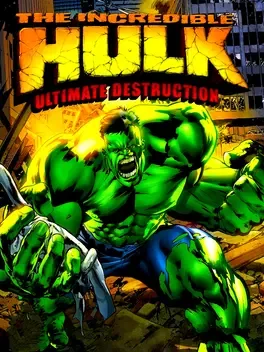
The Incredible Hulk: Ultimate Destruction
Introduction
Released in 2005, The Incredible Hulk: Ultimate Destruction remains one of the most celebrated superhero titles in gaming history. Developed by Radical Entertainment and published by Vivendi Universal Games, this title broke the mold of previous licensed games by offering players something they had long craved: the unfiltered, raw power of the Jade Giant in a fully interactive open world. Unlike its predecessors, which often felt constrained by linear level design, Ultimate Destruction lived up to its name by allowing players to treat the entire city as their playground—or their personal punching bag. It was a landmark achievement that proved superhero games could be mechanically deep, narratively engaging, and, most importantly, incredibly fun.
Story & Setting
The narrative of The Incredible Hulk: Ultimate Destruction takes a deeper dive into the psyche of Bruce Banner than most action games of its era. The plot follows Banner as he attempts to find a permanent cure for his condition while hiding in a remote desert location. Guided by his human consciousness and the telepathic assistance of his friend and psychotherapist, Dr. Leonard Samson, Banner works to construct a massive machine designed to heal his fractured mind. The stakes are high; they aren't just trying to stop the Hulk's rampages, but are specifically trying to prevent the emergence of a much darker, more malevolent personality lurking within Banner's subconscious. As the military, led by the relentless Emil Blonsky, closes in, the Hulk must gather various components for the device across both sprawling urban environments and desolate badlands, leading to a confrontation that tests the limits of his strength.
Gameplay
The core of the experience is the "Unstoppable Movement" and "Weaponization" systems. Radical Entertainment crafted a movement set that allowed the Hulk to run up the sides of skyscrapers, leap across multiple city blocks, and sprint at incredible speeds, making traversal feel powerful and fluid. The combat is equally robust, featuring a deep list of unlockable abilities and combos.
One of the most innovative features is the ability to turn almost any object in the environment into a weapon. Players can tear a city bus in half to use as giant metal boxing gloves, flatten a car into a shield to deflect missiles, or even uproot a light pole to use as a spear. These mechanics, combined with completely destructible buildings and interactive environments, ensure that every battle feels chaotic and impactful. Beyond the main story, the game is packed with side missions, ranging from time trials to "Hulk-sized" golf, providing players with plenty of opportunities to master the Hulk's diverse skill set.
This game was released on several major consoles during the sixth generation of gaming, ensuring fans of all hardware could enjoy the carnage.
Legacy
The Incredible Hulk: Ultimate Destruction is frequently cited as the gold standard for Hulk games and a precursor to the modern open-world superhero genre. Its influence is most notably seen in Radical Entertainment’s later work, Prototype, which borrowed heavily from the movement and combat systems established here. Critics praised the game for its sense of scale and the sheer joy of its destruction mechanics. Even decades later, it remains a favorite among retro gamers and Marvel fans, often being compared favorably to modern hits like Marvel's Spider-Man or the Batman: Arkham series for how well it captures the essence of its titular character’s power fantasy.
Fun Facts
- The game features the voice of Neal McDonough as Bruce Banner, while the legendary Ron Perlman provides the voice for the primary antagonist, Emil Blonsky.
- The script was co-written by Paul Jenkins, a veteran Marvel Comics writer known for his influential run on the Incredible Hulk comic series.
- If players manage to collect enough hidden tokens, they can unlock various skins, including Joe Fixit (the grey Hulk) and even Bruce Banner himself, though playing as Banner results in a much more difficult and humorous experience.
- The game’s "Devil Hulk" storyline was one of the first times this specific comic book concept was introduced to a mainstream gaming audience.