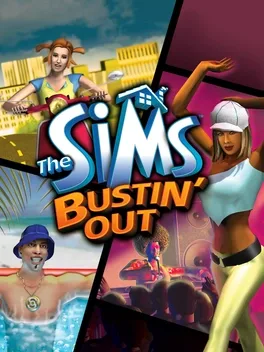
The Sims Bustin' Out
Introduction
In the early 2000s, Maxis and Electronic Arts took a bold step by bringing their life-simulation juggernaut to home consoles. Released in late 2003, The Sims Bustin' Out stands as the second title in the console series and notably marked the first time a major Sims title was developed specifically for consoles without a direct PC counterpart. Known in some regions as Les Sims : Permis de sortir, the game expanded significantly on the foundations laid by its predecessor, offering a more structured, goal-oriented experience that resonated with players who preferred a sense of progression over the pure sandbox of the original. By blending the core mechanics of social management with a clear objective-driven campaign, it carved out a unique space in the franchise's history.
Story & Setting
The core narrative of The Sims Bustin' Out centers on your Sim's journey to financial and social independence. Unlike the PC versions which were largely sandbox-driven, the "Bust Out" mode introduces a clear antagonist: Malcolm Landgrabb. The story begins at your Mom's house, where you are tasked with finding a job and eventually moving out. As you climb the career ladder, you move into increasingly eccentric and luxurious properties. From the high-tech environment of the Shiny Things Lab to the romantic and vibrant vibes of Casa Caliente, each location serves as a thematic hub that reflects your Sim's current lifestyle and career path. The goal is ultimately to reclaim the various items Malcolm has repossessed from your friends and family, culminating in a showdown at his opulent mansion.
Gameplay
The gameplay is divided into two primary modes. The "Bust Out Mode" is mission-based, requiring players to complete specific objectives—such as making friends, improving skills, or purchasing certain items—to unlock new careers and social hubs. This structure provides a satisfying loop of rewards and discovery. For those who miss the classic experience, "Freeplay Mode" offers an open-ended sandbox similar to the original The Sims PC game, allowing for total creative control without the pressure of missions.
Mechanically, the game utilizes the same 3D environment and engine as the first console port but incorporates a wealth of content from various PC expansion packs, including The Sims: Livin' Large, The Sims: Hot Date, and The Sims: Superstar. This includes social interactions, objects, and NPCs that were previously exclusive to PC users. A major innovation for the series was the ability to actually leave the home lot. Players can get out of the house to visit other locations by using their scooter or van, making the world feel much larger and more interconnected than ever before.
This game was released on several platforms, including the Game Boy Advance, GameCube, PlayStation 2, Xbox, and N-Gage.
Legacy
The Sims Bustin' Out is often remembered as the moment the console version of The Sims established its own unique identity. It proved that the simulation formula could be successfully adapted into a mission-driven format without losing its soul. The game's success paved the way for future story-focused entries like The Sims Urbz and the console-specific versions of The Sims 2. For many players, it was their first introduction to the humor and charm of the series, and it remains a cult favorite for its distinct 2000s aesthetic, its catchy soundtrack, and its engaging progression system.
Fun Facts
- The PlayStation 2 version featured a dedicated online mode called "Online Weekend," which allowed players to chat and exchange items, a precursor to modern online social sims.
- The Game Boy Advance version was remarkably different from the home console versions, playing more like an adventure RPG with a top-down perspective and mini-games.
- Players could connect their Game Boy Advance to the GameCube version via a link cable to unlock a hidden mini-game and even transfer their Sim between the two platforms.
- Many of the characters introduced in this game, like the Landgrabbs, would go on to become staples of The Sims lore in later mainline entries.