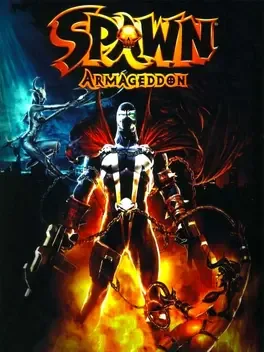
Spawn: Armageddon
Introduction
Spawn: Armageddon is a dark and visceral 3D action-adventure title that captures the gritty essence of Todd McFarlane’s iconic comic book anti-hero. Released during the height of the 128-bit console era, the game was designed to satisfy fans who had long waited for a definitive interactive experience featuring Al Simmons. Unlike previous attempts to bring the character to life, Armageddon benefited from the direct involvement of the creator himself, ensuring that the visual style and narrative tone remained faithful to the source material. It represents a time when comic book adaptations were becoming increasingly ambitious, moving beyond simple brawlers into complex action titles with deep lore and atmospheric storytelling.
Story & Setting
The narrative of Spawn: Armageddon takes place against the backdrop of an impending apocalypse, a central theme in the Spawn mythos. Al Simmons, a former government assassin betrayed and sent to Hell, returns to Earth as a Hellspawn. The game explores his eternal struggle, caught in the crossfire of a cosmic war between the forces of Heaven and the legions of Hell. Todd McFarlane contributed the storyline, which sees Spawn attempting to prevent the total destruction of the world. As the celestial and demonic armies prepare for their final confrontation, Spawn must navigate the decaying streets of New York City and the fiery depths of the underworld to find a way to stop the clock on Armageddon. The setting is masterfully crafted to reflect the gothic, urban decay that defined the original Image Comics series.
Gameplay
Gameplay in Spawn: Armageddon is built around high-octane combat and the creative use of Spawn's supernatural abilities. Players control Spawn from a third-person perspective, utilizing his living symbiotic suit to perform devastating attacks. The signature chains of the suit serve as versatile weapons, capable of striking enemies from a distance or pulling them in for closer engagement. Beyond his innate abilities, Spawn has access to a wide array of conventional firearms, including shotguns and submachine guns, which can be upgraded throughout the game.
One of the most engaging aspects of the combat is the use of "Hell Powers." These special abilities consume necroplasm and allow Spawn to unleash devastating area-of-effect attacks or defensive maneuvers. For melee enthusiasts, Spawn wields Agony, a massive battle axe that provides a heavy alternative to his chain attacks. The game balances these combat encounters with light platforming elements, where Spawn uses his cape to glide across gaps or climb to higher vantage points. The progression system allows players to collect items and power-ups to enhance Spawn's health and necroplasmic energy, providing a sense of growth as the difficulty ramps up.
This game was released on several platforms, including the PlayStation 2, the original Xbox, and the Nintendo GameCube.
Legacy
Spawn: Armageddon is often remembered as one of the better representations of the character in video games. While critics at the time were divided on its repetitive combat and linear level design, fans of the series praised it for its atmosphere and the way it integrated Spawn’s various powers. It successfully translated the visual flair of the comics into a 3D space, providing a template that later superhero games would refine. In the years since its release, it has become a cult classic for collectors and fans of early 2000s action games, standing as a testament to the enduring popularity of Todd McFarlane's creation.
Fun Facts
- The melee weapon Agony is the same axe used by Spawn during his guest appearance in the Xbox version of SoulCalibur II.
- Todd McFarlane didn't just provide the story; he was heavily involved in the art direction to ensure the character's cape and chains moved "correctly."
- The game features a soundtrack filled with heavy metal and industrial tracks, perfectly matching the dark and aggressive tone of the gameplay.
- Armageddon was the first Spawn game to really emphasize the use of firearms alongside supernatural powers, reflecting Al Simmons' background as a soldier.