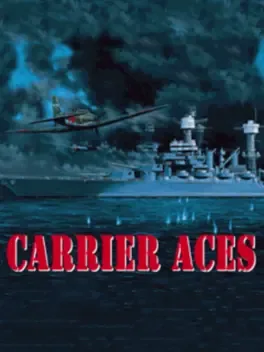
Carrier Aces
Introduction
In the early 1990s, flight simulators were often the domain of high-end PCs, but the Super Nintendo Entertainment System sought to bring that cockpit-bound excitement to living rooms across the globe. Among the titles that defined this era for the console was Carrier Aces, a third-person flight simulator that transported players to the turbulent skies of the 1940s. Developed with a focus on tactical dogfighting and naval warfare, it stood out by eschewing the full-screen perspective common in most console games. Instead, it embraced a permanent split-screen format, creating a constant sense of rivalry whether you were playing against a friend or a computer-controlled ace. For many 16-bit gamers, this was their first real taste of the tension inherent in carrier-based operations.
Story & Setting
Carrier Aces is set during the height of World War II, specifically focusing on the Pacific Theater of operations. The game places players in the boots of an aircraft pilot serving either the United States or the Japanese Empire. The narrative is driven by the strategic struggle for dominance over the ocean, where the aircraft carrier serves as both a home base and a mobile fortress. This setting isn't just window dressing; it dictates the flow of the entire game. Missions start and end with the daunting task of launching from and returning to these massive ships. The rivalry between the two nations is depicted through a series of tactical engagements that mirror the historical island-hopping campaigns and naval clashes of the era.
Gameplay
The core of Carrier Aces lies in its diverse mission structure and its unique split-screen presentation. Regardless of whether you are playing solo or with a partner, the screen is divided in half; the second player or the AI opponent occupies the other half, allowing both perspectives to be seen simultaneously. Players have access to several mission types, including classic 1vs1 dogfights, strafing runs on enemy vessels, high-stakes dive bombing, and precision torpedo runs.
One of the more complex aspects of the game is the campaign mode. Here, players move across an area map to engage the enemy. When forces meet, the game transitions to a tactical selection screen where players decide which aircraft to bring into the fray based on specific statistics. Once in flight, the controls are surprisingly nuanced. Pilots can tilt, climb, dive, and adjust their speed to gain an advantage, even performing a dramatic 180-degree loop to shake off a tail.
Interestingly, the game shifts mechanics during ship combat. While one player pilots their aircraft to deliver a payload, the other player takes command of the ship's turret guns. This role is more stationary but no less vital, requiring the player to aim, zoom, and fire to defend their vessel from the incoming aerial threat. Successful missions often conclude with a carrier landing, a feat of skill that remains one of the most challenging mechanics in the game.
This game was primarily released on the Super Nintendo Entertainment System, catering to both the North American and European markets.
- SUPER NINTENDO ENTERTAINMENT SYSTEM: PAL, NTSC-U
Legacy
Carrier Aces is remembered fondly by flight simulation enthusiasts for its ambitious use of the Super Nintendo's hardware. While it didn't achieve the same mainstream fame as titles like Star Fox or Pilotwings, it was respected for its commitment to a more "serious" simulation style on a home console. Its permanent split-screen approach was a bold design choice that emphasized the 1vs1 nature of aerial combat, though it remained a divisive feature for those who preferred a larger field of view. Today, it stands as a testament to the creative ways developers utilized the SNES's Mode 7 capabilities to simulate three-dimensional movement and scale.
Fun Facts
- Even when playing a single-player campaign, the screen remains split. The AI's movements are always visible, giving you a "cheat sheet" of sorts to track their maneuvers.
- The turret gameplay includes a dedicated zoom function, which was quite advanced for a secondary mechanic in a 16-bit flight sim.
- Unlike many arcade-style shooters of the time, Carrier Aces requires players to manage their speed carefully; slowing down too much can lead to a stall, especially during tricky carrier landings.
- The game features no alternative names and was released consistently as Carrier Aces across all regions.