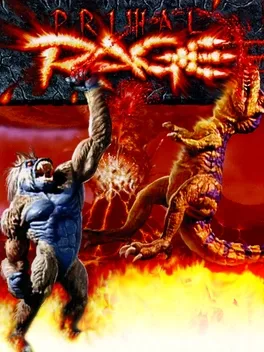
Primal Rage
Introduction
In the mid-1990s, the fighting game genre was undergoing a massive transformation. While titles like Street Fighter II and Mortal Kombat dominated the arcades, developers were constantly looking for the next big hook to capture the attention of players. Atari Games stepped into the arena with Primal Rage, a visually stunning and visceral title that replaced traditional martial artists with towering prehistoric beasts. Utilizing digitized stop-motion animation, the game offered a gritty, textured look that felt distinct from its contemporaries. It quickly became a sensation, blending the competitive mechanics of a 2D fighter with the sheer spectacle of giant dinosaurs and apes tearing each other apart in a post-apocalyptic wasteland.
Story & Setting
The narrative of Primal Rage begins with a global catastrophe known as "The Cataclysm." A massive meteor struck the Earth, wiping out modern civilization and reshaping the continents into a single landmass now referred to as "Urth." This environmental upheaval had an even more profound effect: it awakened seven ancient gods who had been slumbering deep within the planet for eons.
These deities, appearing as prehistoric creatures, are not merely mindless animals; they are powerful beings vying for absolute control over the remnants of the world and the primitive human tribes that worship them. The roster includes characters like Blizzard, the god of virtue, and Diablo, the god of evil, each leading their followers into a brutal conflict to determine the ultimate ruler of the new Urth. The setting is bleak, primitive, and filled with the ruins of the human world, providing a haunting backdrop for the titanic clashes that follow.
Gameplay
Primal Rage is a one-on-one fighting game that adopts a side-view perspective similar to Mortal Kombat. The combat is fast-paced and emphasizes heavy hits and special abilities. One of the most unique aspects of the gameplay is its input system. Instead of the standard "motion then button" inputs found in many fighters, Primal Rage often required players to hold down a specific combination of buttons and then perform the joystick movement. This added a layer of tactical complexity, as players had to anticipate their moves while maintaining their defensive stance.
Each fighter possesses a range of special moves, such as Blizzard’s freezing breath or Chaos’s acidic projectiles. The game also features a unique health system where players can devour the tiny humans running across the bottom of the screen to regain health. True to the trends of the 90s, the game includes "Finishing Moves," allowing the winner to execute their opponent in a gruesome fashion at the end of the final round. These finishers range from shocking transformations to lethal displays of prehistoric power.
This game was released on several platforms, including the Sega 32X, PlayStation, Sega Saturn, Game Gear, Sega Mega Drive/Genesis, and the Super Nintendo Entertainment System.
Legacy
Primal Rage remains a significant chapter in arcade history, primarily due to its innovative use of claymation and stop-motion technology. While many games of the era were moving toward early 3D polygons, Primal Rage doubled down on physical models, giving the characters a sense of weight and realism that was rare at the time. Although the game never received a full retail sequel—despite a high-profile cancellation of Primal Rage II—it spawned a dedicated cult following, a line of action figures, and even a novel. It stands as a definitive example of the "fighting game craze" of the 90s, remembered for its daring art style and its unapologetic brutality. Primal Rage has no alternative names.
Fun Facts
- The stop-motion puppets used for the digitized sprites were created by professional animators and featured complex armatures to allow for high-quality movement frames.
- The character Chaos was notoriously controversial due to a specific finishing move involving urination, which led to the game being censored or pulled from certain retail shelves in North America.
- The game features a hidden "Volleyball" mini-game that can be triggered if two players perform specific actions, replacing the combatants with their human worshippers tossing a head back and forth.
- Despite the sequel being cancelled, a few functional arcade boards of Primal Rage II exist and have been showcased at gaming conventions, revealing that the sequel would have featured "Avatars" (human-sized warriors) who could transform into the original gods.