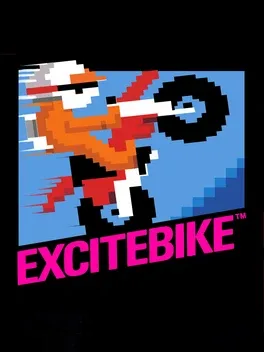
Excitebike
Introduction
When gamers think of the early days of the 8-bit era, a few iconic images immediately spring to mind: a plumber in a mushroom kingdom, a hero in a green tunic, and a pixelated red motocross bike soaring through the air. Released in Japan for the Family Computer in 1984 and later as a launch title for the NES in 1985, Excitebike remains a cornerstone of racing game history. Often referred to by its alternative name Excite Bike or known in some regions as Мотогонки, it was the first title in what would become the enduring Excite series. Designed by the legendary Shigeru Miyamoto, the game captured the raw energy of motocross and condensed it into a side-scrolling experience that emphasized physics, timing, and strategy. For many, this title represents the pure, unadulterated fun of early console gaming, offering a level of polish that helped define Nintendo as a titan of the industry.
Story & Setting
Unlike many of its contemporaries that relied on complex narratives, Excitebike is built entirely around the competitive spirit of professional racing. The game places players in the boots of a professional rider striving to qualify for the championship circuit. The setting consists of various stadium-style dirt tracks filled with mud pits, massive ramps, and treacherous obstacles. While there is no dialogue or deep character backstories, the narrative is told through the player's progression from a lone rider in heat trials to a racer surrounded by aggressive competitors on the world stage. The atmosphere is purely athletic and high-stakes, focusing on the roar of the engines and the tension of landing the perfect jump while the crowd cheers in the background. It is a world of dirt, oil, and adrenaline where the only thing that matters is the time on the clock.
Gameplay
The brilliance of Excitebike lies in its deceptive simplicity and advanced physics. Players navigate tracks from a side-view perspective, using two main acceleration modes. Button A provides standard speed, while Button B acts as a turbo boost. However, using the turbo generates significant heat; if the thermometer on the bottom of the screen fills up, the bike stalls, forcing a time-consuming cool-down period. Mastery involves balancing speed with heat management by driving over cooling strips on the track. The physics system was revolutionary for its time; players must tilt their bike mid-air to ensure they land parallel to the ground to maintain momentum. Landing incorrectly or clipping an opponent’s wheel leads to a crash, where the player must frantically tap buttons to return to their bike. Additionally, the game featured a revolutionary "Design" mode, allowing players to create their own custom tracks, featuring all the jumps and obstacles found in the main game.
The game's accessibility has spanned several generations of hardware, making it a staple for retro enthusiasts across the globe.
Legacy
Excitebike is more than just a nostalgic memory; it is a foundational text in the racing genre. Its success led to several sequels and spin-offs, including Excitebike 64, Excite Truck, and Excitebots: Trick Racing. The inclusion of the track editor was decades ahead of its time, inspiring future generations of game developers to include user-generated content in their projects. Even decades later, the game is frequently re-released on modern consoles via digital services, and its protagonist, the Excitebike Racer, has made appearances in titles like Super Smash Bros. and as a playable track in Mario Kart 8. Its impact on the industry is solidified by its status as one of the best-selling games on the NES, proving that tight controls and addictive mechanics are truly timeless.
Fun Facts
Despite being a launch title for the NES, Excitebike was actually produced by Shigeru Miyamoto, the same creative mind behind Super Mario and The Legend of Zelda. In the original Japanese version for the Family Computer, players could actually save their custom tracks using a peripheral called the Famicom Data Recorder, a feature that was largely unavailable to Western audiences until much later. Another interesting detail is that the game’s engine was used as a base for several other early Nintendo projects due to its sophisticated handling of physics and sprite movement. The title Мотогонки remains a popular way to refer to the game in Russian-speaking regions, where it gained a massive following through various hardware clones during the early 1990s.