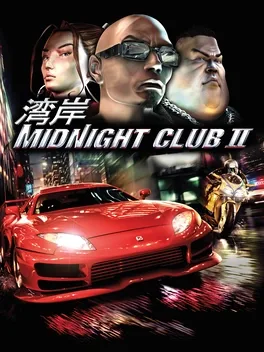
Midnight Club II
Introduction
In the early 2000s, the landscape of arcade racing was forever changed by the high-octane thrill of street racing culture. Midnight Club II, also frequently referred to as Midnight Club 2 or simply MC2, arrived as a groundbreaking sequel that elevated the series into a household name. Developed by Rockstar San Diego, formerly known as Angel Studios, this title took the foundational concepts of its predecessor and expanded them with more speed, more cities, and more attitude. As the first sequel in what would become a legendary franchise, it bridged the gap between the arcade roots of the original and the massive lifestyle-focused hits that would follow. For fans of the era, it remains a high-water mark for pure, skill-based racing that refused to hold the player's hand.
Story & Setting
While many racing games focus on closed circuits, MCII immerses players in a world of illegal, underground competition. There is no formal track; instead, the world itself is the course. The game features three distinct, meticulously recreated metropolitan areas: Los Angeles, Paris, and Tokyo. Each city captures the essence of its real-world counterpart while optimizing the layout for high-speed chases. In Los Angeles, players navigate sprawling freeways and sun-drenched boulevards. Paris offers narrow, winding cobblestone streets and iconic landmarks that provide both beauty and navigational challenges. Finally, Tokyo brings a neon-drenched atmosphere filled with tight corners and dense urban architecture. The narrative follows a nameless protagonist who must climb the ranks of the international street racing circuit, defeating local champions to earn their respect and their vehicles.
Gameplay
What truly defines Midnight Club 2 is its uncompromising gameplay mechanics. It is an open-world racer where players must pass through a series of checkpoints in any order they choose to reach the finish line. This freedom of navigation means that knowledge of the city's shortcuts and hidden paths is just as important as driving skill. The game introduced several advanced maneuvers that became staples of the series, such as the Slipstream Turbo, which allows players to gain a speed boost by drafting behind opponents, and two-wheel driving to squeeze through narrow gaps. Additionally, MC2 was the first in the series to introduce motorcycles, adding a new layer of risk and reward. The AI is notoriously aggressive and skilled, making every race a tense battle where a single mistake can lead to a total loss of the lead. The addition of an online multiplayer component also allowed players to test their skills against others globally, a significant feature for its time.
This game was released on several platforms, including the PlayStation 2, Xbox, and Microsoft Windows, and later saw a digital release on the PlayStation Network for the PlayStation 3.
Legacy
Midnight Club II is remembered as one of the most challenging and rewarding racing games of its generation. It set the stage for Midnight Club 3: DUB Edition by proving that open-world racing could be both technical and stylish. Critics at the time praised its sense of speed and the density of its urban environments, noting that it captured the "illegal" feel of street racing better than many of its contemporaries. While the franchise has been dormant for some years, the influence of MC2 can still be seen in modern open-world titles that emphasize player choice in navigation. It remains a cult favorite among speedrunners and arcade racing enthusiasts who appreciate its steep learning curve and lack of rubber-band AI, which ensures that victories are truly earned through mastery of the mechanics.
Fun Facts
Despite the realistic look of the vehicles, none of the cars in Midnight Club II are officially licensed. Rockstar San Diego chose to create fictional vehicles based on real-world counterparts to allow for more visual damage and spectacular crashes without manufacturer restrictions. Additionally, the game was one of the first major racing titles to feature a functional 'in-air control' mechanic, allowing players to tilt their cars during jumps to ensure a perfect landing. Another interesting fact is that several characters from the game make cameo appearances or are referenced in other Rockstar titles, reinforcing the shared universe often hinted at in their early 2000s library. Finally, the game's soundtrack is highly regarded for its blend of techno, trance, and hip-hop, which perfectly complemented the late-night aesthetic of the races.