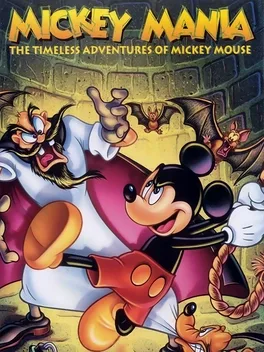
Mickey Mania: The Timeless Adventures of Mickey Mouse
Introduction
In the early 1990s, Disney characters were the undisputed royalty of the 16-bit era. While many titles featured the iconic mouse, few captured the essence of his history as vividly as Mickey Mania: The Timeless Adventures of Mickey Mouse. Developed by Traveller's Tales and published by Sony Imagesoft, this title was more than just a standard side-scroller; it was a playable museum of animation. Often referred to simply as Mickey Mania, or by its localized title in certain regions as Mickey Mania: As Eternas Aventuras de Mickey Mouse, the game served as a tribute to over six decades of cartoon excellence, blending cutting-edge programming with the nostalgic charm of the world's most famous mouse.
Story & Setting
The narrative of Mickey Mania: The Timeless Adventures of Mickey Mouse is as charming as it is straightforward. Mickey Mouse is granted a unique opportunity to travel back through his own history, literally walking down memory lane. The game is structured as a chronological journey through Mickey’s most iconic film appearances, spanning roughly 75 years of animation evolution.
The journey begins in the monochromatic world of 1928’s Steamboat Willie, where the world first met the mischievous mouse. From there, players are transported into the eerie, gothic atmosphere of The Mad Doctor (1933) and the vibrant, outdoor chaos of Moose Hunters (1937). The setting shifts again to the spooky corridors of Lonesome Ghosts (1937) and the towering heights of Mickey and the Beanstalk (1947). The adventure eventually concludes with a grand finale based on the 1990 featurette The Prince and the Pauper. Each world is meticulously designed to mirror the art style and atmosphere of the original cartoons, making the setting feel like a living piece of Disney history.
Gameplay
At its core, Mickey Mania: The Timeless Adventures of Mickey Mouse is a classic 2D platformer that prioritizes atmosphere and precision. Mickey’s primary means of interaction are jumping on enemies and throwing marbles. Marbles serve as a projectile weapon with limited ammunition, forcing players to explore the levels to find refills. This mechanic adds a light layer of resource management to the otherwise straightforward action.
Beyond basic combat, the game incorporates various puzzle elements and environmental hazards that require quick thinking. For instance, in the Steamboat Willie level, Mickey must navigate moving platforms and avoid steam vents, while The Mad Doctor level introduces more complex traps and vertical navigation. The gameplay also features "chase" sequences and boss encounters that reference the specific plots of the cartoons they represent. The difficulty is notable; while it looks like a children’s game, the precise platforming and enemy placement offer a fair challenge even for seasoned gamers.
This game was released on several platforms, including the Super Nintendo and the Sega Genesis, allowing a wide audience to enjoy Mickey’s historical trek.
Legacy
Mickey Mania remains a high-water mark for licensed video games. It was a breakout project for Traveller's Tales and its founder, Jon Burton, who would later go on to create the massive LEGO video game franchise. The game was lauded for its technical prowess, particularly the way it integrated high-quality hand-drawn animation—often provided by actual Disney animators—into a 16-bit environment.
Critically, the game was praised for its visual fidelity and the seamless way it transitioned from the black-and-white aesthetic of the first level into the lush colors of the later eras. It set a standard for how to handle a legacy property, showing that a licensed game could be both a commercial success and a genuine love letter to the source material. Even decades later, it is frequently cited as one of the best Disney games of all time.
Fun Facts
- The opening level, Steamboat Willie, starts entirely in black and white. As Mickey progresses through the level, the environment slowly gains color, representing the technological transition of the animation industry.
- During development, Disney animators were brought in to ensure that Mickey’s movements perfectly matched his cartoon counterparts, a rare level of collaboration for the time.
- While the Sega CD and Genesis versions included a level based on The Band Concert, the Super Nintendo version had to omit it due to storage limitations and technical differences.
- In every level, the “modern” Mickey meets his “past self” at the end of the stage, creating a heartwarming moment where the two versions of the character interact briefly.