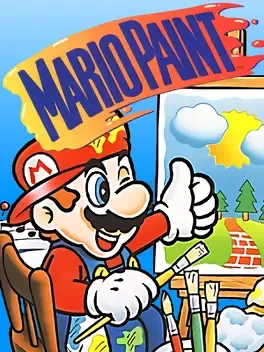
Mario Paint
Introduction
In 1992, Nintendo released a title that challenged the very definition of what a "video game" could be. That title was Mario Paint, a creative suite that transformed the Super Nintendo Entertainment System (SNES) from a platform for jumping on Goombas into a digital canvas for budding artists and musicians. Packaged with the unique SNES Mouse, Mario Paint allowed users to explore their creative side in an era long before tablet drawing and digital workstations were household staples. It remains one of the most innovative experiments in Nintendo’s history, blending the charm of the Mario franchise with powerful, accessible creative tools.
Story & Setting
Unlike traditional Mario adventures, Mario Paint does not feature a narrative where the titular plumber saves Princess Peach from the clutches of Bowser. Instead, the "setting" is the player’s own imagination. Mario himself acts as a cheerful guide and cursor, popping up to react to your creations or providing whimsical transitions between different modes. The game provides a blank digital canvas, a staff for musical notation, and a workspace for animation, inviting players to build their own worlds rather than just exploring one pre-designed by developers.
Gameplay
The core experience of Mario Paint revolves around its specialized peripheral: the SNES Mouse. This hardware allowed for precise control that was impossible with a standard D-pad. The game is divided into several distinct modules. In the drawing mode, players can paint over black and white templates or create their own art from scratch using a variety of brushes, spray cans, and textures. A vast library of stamps—featuring characters from the Mario and Yoshi universes—could be placed and even edited pixel by pixel.
Beyond visual art, the Music Composer is perhaps the game's most beloved feature. It offers a staff where players place different icons representing instruments—ranging from traditional pianos and trumpets to quirky sounds like cats meowing, pigs oinking, and baby rattles. This allowed for the creation of surprisingly complex melodies. Additionally, the game includes an animation tool where players can create simple, looping 4-frame or 9-frame sequences. For those needing a break from the creative process, Mario Paint includes "Gnat Attack," a frantic mini-game where players use the mouse to swat waves of flies and dodge insect bosses, providing a satisfying arcade-style diversion.
This game was released on several platforms within the Nintendo ecosystem, primarily serving as the flagship title for the SNES Mouse peripheral.
Legacy
The legacy of Mario Paint is immense, stretching far beyond its initial release. It is often cited as a precursor to the modern "maker" genre, most notably influencing the development of the Super Mario Maker series. Many of the sound effects and the general philosophy of creative play were directly inherited by later Nintendo projects.
In the internet age, the game’s Music Composer gained a second life. Fans created "Mario Paint Composer" software for PC, leading to a massive community that produces elaborate covers of modern pop songs and game soundtracks using the game's iconic 16-bit animal sounds. It proved that provided with the right tools, the gaming community would continue to create and share content decades after the original hardware became obsolete.
Fun Facts
- Totaka's Song: If you click on the "O" in the title screen, you can hear a secret 19-note melody hidden by composer Kazumi Totaka, a signature Easter egg found in many Nintendo games he worked on.
- The Undog: The "undo" function in the drawing mode is represented by a small dog icon. Clicking it reverts your last action, leading fans to affectionately call it the "Undog."
- Mouse Pad: The original retail box for Mario Paint was significantly larger than standard SNES games because it included not only the game cartridge and the mouse but also a hard plastic mouse pad.
- Coffee Break: If you leave the game idle on the title screen for too long, Mario will eventually sit down and take a coffee break, one of the many charming "idle animations" that gave the software its personality.